
Quick-fire Reviews
Fun but lightweight.

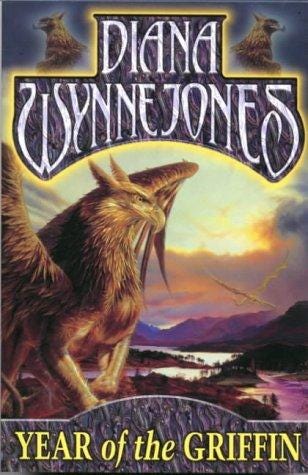
The Year of The Griffin by Diana Wynne Jones.
This is a very odd story about a group of undergraduate friends at a magical university, one of whom is a large, golden griffin. Each person in the group is fleeing some kind of crisis at home and they are all disappointed to arrive at the Wizards’ University and find that there is an emphasis on rote learning and their tutor, Wizard Corkoran, is too wrapped up in his personal moonshot research to teach them.
This was not quite a kids book, nor quite a YA, nor adult fiction. It isn’t bad but I don’t know who this for.1
“It’s for undergraduate griffins! Obviously!”says The Teen.
I think the University experience in the story needs to be bought up to date: the Wizard’s University doesn’t need to send begging letters to parents because it costs £10,000 a year in tuition fees. When the students arrive they should discover there is no contact time with feckless researcher Wizard Corkoran because he’s put all his lectures online. And he made them using AI. Which the students are not allowed to use for essays or they will be expelled.
I Was Told There’d Be Cake by Sloane Crosley
If David Sedaris was a millennial woman.
I’ll Leave It To You - A Play in Three Acts by Noel Coward
I had the urge to read Private Lives and went looking at Project Guttenberg to see whether it was available. It wasn’t, so I ended up with this light comedy instead.
The setting is between the wars and Mrs Dermot is struggling for money to keep up her big country house since the death of her husband. Her four adult children are no help and her only hope is her rich brother in South America. When “Uncle Daniel” visits, he tells the children he will leave his fortune to whichever one of them has made the most money in 3 years time. This motivates them to set to work - which is just as well since it turns out that Uncle Daniel has no money either.
I’d rate the play as mostly harmless. It’s no Blithe Spirit, but Mr Coward does a sterling job of getting the characters on and off stage, preventing the Line of Doom. And it’s more fun than An Inspector Calls.
One thing that always intrigues me about playwrights is how much or how little they say about the practical business of putting on the play. Some say pretty much nothing and leave it up to the director to decide how to interpret their work. Others get control-freaky and start to specify every little thing. Noel Coward is in the second camp. There is a diagram of the set, a list of exactly what light bulb goes where to create the right effect and a list of props which includes the 8 teaspoons that are apparently needed for the breakfast scene. Don’t try putting the play on with 7 teaspoons, that’s not enough and 9 is too many - that extra spoon will look stupid. I’m afraid I laughed more at Coward’s over-precise teaspoon requirements than I did at any of his actual jokes.

King of Scars by Leigh Bardugo
The generic fantasy of generic-ness.
Every time I read a book and fail to understand what it was supposed to be and who it was supposed to appeal to, I imagine some literary agent reading my work and thinking the same thing! How to get the right story to the right reader without giving up and writing cliches? It’s an issue…